Tales from Beyond: Daniel Beutler
What do people do post-Mastered?! In this series we talk with Graduates to hear their many and varied stories.
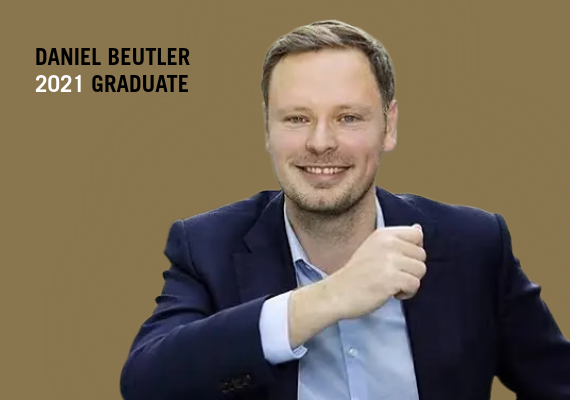
From President & COO of large companies to making coaching their profession, Daniel Beutler shares his story since graduating from Mastered.
What were you doing before the Mastered Programme?
Before Mastered, I was the President of Trainline Intl. and was regularly commuting between Paris and London as well as the majority of other European capitals. Before that I was COO with Captain Train, a Start-Up for Train tickets, which then was acquired by Trainline. In 2019 we listed TRN at the LSE.
Before I joined the Start-Up then Scale-Up world, I was part of the corporate world for one of the biggest logistics companies in the world, where after a few other management stations I became CEO for Western Europe.
What direction have you gone in since finishing the Mastered Programme? What are you doing now?
I have made coaching my profession. Today I do half coaching, half board mandates as NED and NEC. The combination helps me to stay close to the business world and not miss any new developments, but at the same time gives me the opportunity to continue my passion of executive coaching across all industries, mostly European, and often in scale ups, in the phase from founders to leaders to C-level managers.
What impact did the Mastered programme have for you?
A very big one. I completely underestimated the impact that non-directive coaching can have. The ability to truly and proactively listen and create a safe space to listen and think has broadened my horizon. And as uncomfortable as the first few months made me feel, because I thought I would never get there, the more comfortable I am today. And interestingly enough, the best sessions I have now are those that I prepare the least. This is because I don’t feel that my value is by telling them what to do, but instead by understanding what it is they actually ask for. Today, I have found my perfect blend between non-directive coaching and offering input and feedback when needed.
What are some examples of things you have done differently since the Mastered programme?
Understanding that you need to be clear about whom you contract with, “is it the company or the coachee directly?” and being clear on the loyalty aspect from the beginning. Before that framework is understood, there is no way the coaching time can be a success.
Also understanding that coaching and psychology are two different things. I regularly hear family stories, and that’s a great sign of trust and the context is highly valuable for the success of coaching, but I learned to make clear that I can’t help with the aspects of solving the ‘beyond coaching issues’, because I’m not trained for that and could do more harm than good.
What was the most valuable thing you got from Mastered that you are using now?
Definitely proactive listening and applying the non-directive style.
Where do you see yourself going in the future?
I chose the coaching profession because I love it, not at the end of my career, but in the midst. I feel there is so much more in it for me and for my clients, and I hope to become best in class in a decade or so. Until then, I try to get better and question myself and my techniques and style every day and ask a lot for feedback and supervision to make sure I can thrive in it.
I will want to keep the NED and NEC parts of my lifestyle, because not being part of any team is something I would miss. In fact, a head-hunter couldn’t believe that I won’t be taking on the next CEO gig soon and was surprised about my reluctance! If I could do this for the rest of my life, I would consider myself more than lucky.
Anything else you would like to say?
Coaching is extremely hyped at the moment, and as everything else that is hyped, it brings a lot of charlatans on the plan. Anybody can call themselves a coach today. The upside is speaking to a coach is not considered a weakness anymore, but the downside is that the quality level is decreasing, and more people have poor experiences. We have the obligation to change that. For our community, for our coachees and for ourselves.
About Daniel
Daniel is 41 years old, married and father of a little boy. Born and raised in Hamburg, Germany, he lived and worked in many parts of the world, the last decade in Paris, before he moved back closer to his hometown. After 5 years as a corporate CEO with Deutsche Bahn, a leading mobility company, he continued his career in the start-up world to become COO of Captain Train. Following the acquisition by Trainline, which he led in a transformational change process, he became President of Trainline Intl and a leader to create one of the biggest European tech hits and IPOs of recent years.
Today, he uses his experience to focus on executive business coaching and advising leaders from both worlds, to accompany them to achieve their goals. Daniel is trilingual (English, French, German) and studied at McGill and Dresden University of Technology, holding a Master’s degree in Transport Economics and is a graduate of the Meyler Campbell Mastered programme.

Subscribe
Join our mailing list to be informed of the new Meyler Campbell Insight resources as they are published