Tales from Beyond: Ivan Schofield
What do people do post-Mastered? In our Tales from Beyond series, we talk with Graduates to hear their many and varied stories.
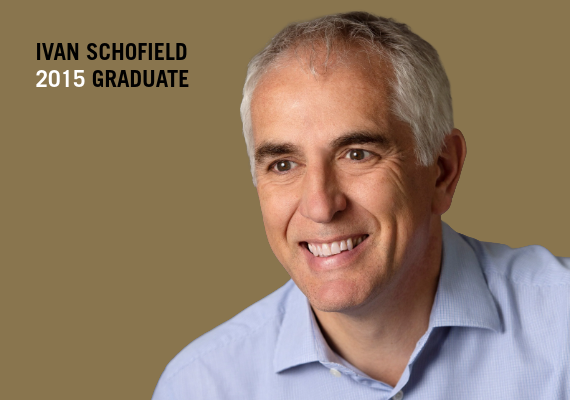
This month, we learn about the journey Mastered Graduate Ivan Schofield has taken to building his own successful coaching practice in 2017 and the ups and downs along the way.
I began my career at Unilever, completed an MBA at INSEAD, worked three years in Strategy Consulting, and then joined Yum Brands. After three years as regional CFO, I became MD/CEO of KFC’s French and Western European business, based in France for 12 years. The parts of the business I led grew from $50m sales to $1.5bn sales over that time and I experienced the ups and downs of leading and building a team and organisation in a role which step-changed in scale every 18 months. I loved the French culture and, whilst running an American fast-food business there was not easy at times, we built a great organisation culture combining, we thought, the best of American and French corporate culture.
Whilst I was and remain fluent in French, when I look back, I realise that speaking a foreign language every day left me feeling on the back foot which, coupled with the seven-day nature of the role, my own simmering imposter syndrome, and the scale and complexity of the role, meant that I was managing an underlying level of stress / anxiety all the time. I see in my coaching work today that this stress is a constant companion for senior leaders and find that I am well placed to help them manage it and, in particular, help them maintain the quality of their presence and communicate effectively in the face of it.
After decades on the executive treadmill, in which the negatively reinforced “always on-ness” of senior leadership was a constant companion, I wanted the second chapter in my career to afford me a lifestyle with more freedom and independence. The time for this came in 2017, at the age of 50, when I “went plural”, building a coaching practice whilst also holding two to three NED roles. I enjoy the challenge of the NED roles and see it as an important part of my practice; it keeps the coaching work real and relevant both for me and my clients, allowing me to see perspectives from all sides of the boardroom table.
Meyler Campbell’s Mastered programme provided an outstanding foundation for my coaching practice. Probably the most powerful thing I learned was to create a reflective space, to observe what is happening within that space and to learn to comfortable being non-directive. Whilst I remain convinced that Mastered is the best coaching programme available with an excellent balance between study and experiential learning, for me, it is still really a foundation course. Most Mastered coaches follow their own path in terms of CPD post qualification. In my case, I found myself unprepared / not competent to help clients deal with the kind of emotional problems that were coming up and this led me down the route of training in various therapeutic fields, notably CBT, Energy Work, Gestalt and elite sports coaching, all of which have found their place in the foundations of my approach to my work today.
Building my business has been a journey. My first few clients came from my close professional network, and I feel very grateful and lucky for those initial referrals which allowed me to build my experience and credibility. At the beginning, my client base was largely in the leisure and hospitality space where most of my professional network sat. Today my coaching business is much broader, covering a wide range of sectors and ownership scenarios, although most of my clients work for companies who are backed by private equity sponsors.
When I look across the cycle, about two-thirds of my clients are leaders who are preparing for, or have just been given, greater responsibilities and the other third are MDs or CEOs. More recently the balance has shifted to closer to 50:50 between the two. For the former group, central to the conversation is Marshall Goldstein’s maxim: “What got you here, won’t get you there” … helping clients reflect on the strengths that helped get them into this position; reflecting on behaviours or habits that might not serve them so well as they move forward and opening up a reflection on how they can use their strengths differently as senior leaders.
I find that certain ingredients are central and powerful for the process … in-depth stakeholder interviews; a detailed exploration of the client’s early life and career; the Hogan Personality Inventory and, where appropriate, a powerful and time-proven 360 psychometric called the Life Style Inventory by Human Synergistics.
It would be wrong for me to say that it hasn’t been tough at times. Hundreds of hours of CPD felt onerous at times and figuring how to develop the business was also a challenge. However, choosing coaching as a second career was a decision that I never regret. Whilst I sometimes miss some aspects of leading an organisation, it soon passes! Choisir, c’est renoncer as the French say. As a friend (who is a private equity partner) said to me recently … “OK you might not be creating something that you can sell but you earn as much as most of our senior executives; you work three days a week doing something you love; you help people; your business has a 100% margin, no capital investment and you don’t have to report to a board with people like me telling you what to do!”
Working as a coach can sometimes feel quite lonely and I am incredibly grateful to the supervisors I have worked with, to my business partner Kate Jones (who was in my Mastered tutor group) and to the amazing individuals in the wider Meyler Campbell community; an incredibly rich resource of outstandingly talented individuals all of whom are following their own purposeful journey.
Written by Ivan Schofield, 2017 Mastered Graduate.
Subscribe
Join our mailing list to be informed of the new Meyler Campbell Insight resources as they are published