Tales from Beyond: Karan Paige
What do people do post-Mastered?! In this new series we talk with Graduates to hear their many and varied stories.
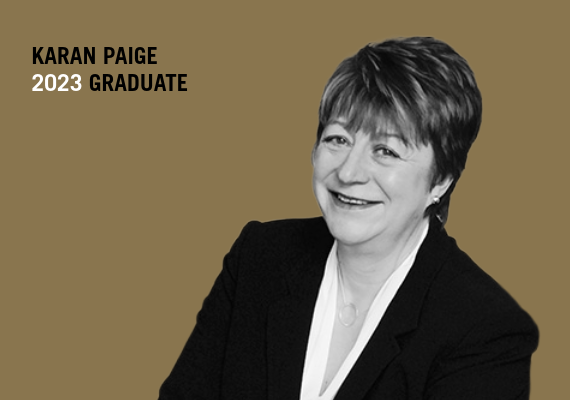
Karan Paige is a consultant and executive coach specialising in supporting companies and leaders through times of opportunity, turbulence, and change.
A question from my tutor during a Mastered tutorial led me to reflect how immersive coaching is. If you coach, coaching will creep outside of your paid work and pop up where you least expect it. Before Mastered I was a consultant who sometimes coached. Now, I realise that I am a coach. Before Mastered I neatly compartmentalised my life into work (transformation consulting, executive coaching, and writing); home (husband and dogs); and other. Now I take a more open view, welcoming opportunities wherever they come from or land.
Knowing that “other” included running a reading group in a domestic abuse refuge, Des (my Tutor) enquired what learnings I might bring from that to my coaching practice. I was taken aback: surely there was no connection? But the more I pondered the more I saw how the reading group had informed my coaching work and increasingly how coaching was colouring my approach to the refuge reading group.
Some early lessons learnt included: not feeling pressure to “run” the session – whether it’s a reading group or a coaching session; having the confidence to ask one or two wondering questions at the outset and then trusting others to do the work. No filling silences with questions, allowing silence to rest where it may – people are thinking!
The more I learnt about Nancy Kline’s work, the more it opened my ears to unspoken messages: a woman hovering at the door of the refuge’s reading room meant interest held back by a limiting assumption that she wasn’t “clever enough”. Acknowledging anxieties by offering the book without pressure to join the group created an opportunity to explore in her own way. One day, I was in the kitchen and noticed a woman reading our choice for that month. On asking if she was enjoying it, she responded with an enthusiastic paean to a character she admired. Remembering a recent tutorial on Kline’s work, I took a deep breath and asked, “If you knew that you could do what that character did, what would be different for you?” She didn’t answer me then, but I later heard she had made some life changing decisions and was now on a positive path with her daughter.
I found I was able to bring a deeper understanding of the concept of psychological safety to my coaching work because of my experiences with the women in my reading group. Their opinions had never been sought, whilst their experience of being asked questions meant only that they were guaranteed to give the wrong answer. Creating an environment where no offered thought is wrong and where questions were experienced as genuine curiosity about their opinions and beliefs was such good grounding for my development as a coach and deepened my belief in the resourcefulness of others.
The reading group has offered up many awesome moments over the five years we have been running it including the lady who gave me a gold standard example of perceptual positions by describing P. G. Wodehouse’s famous manservant Jeeves, as “manipulative and controlling” whilst I had merely thought him rather clever at getting his own way; and the woman who was inspired to believe she could change her life by the example of Flora Poste from Cold Comfort Farm.
I don’t think running a reading group is coaching – or if it is, the credit for coaching should go to the authors that we read. But I am happy to learn that if you coach you are a coach and that is true in everything that you do in life.
Karan Paige

Subscribe
Join our mailing list to be informed of the new Meyler Campbell Insight resources as they are published